ParadoxesParadox 1
Ethics Paradox
Monetization is viewed by some as morally incompatible with the intrinsic value of nature and with climate justice, yet market mechanisms can drive conservation most effectively.
Three flavours
One paradox, three cartoons: three ways into the same trap.
-
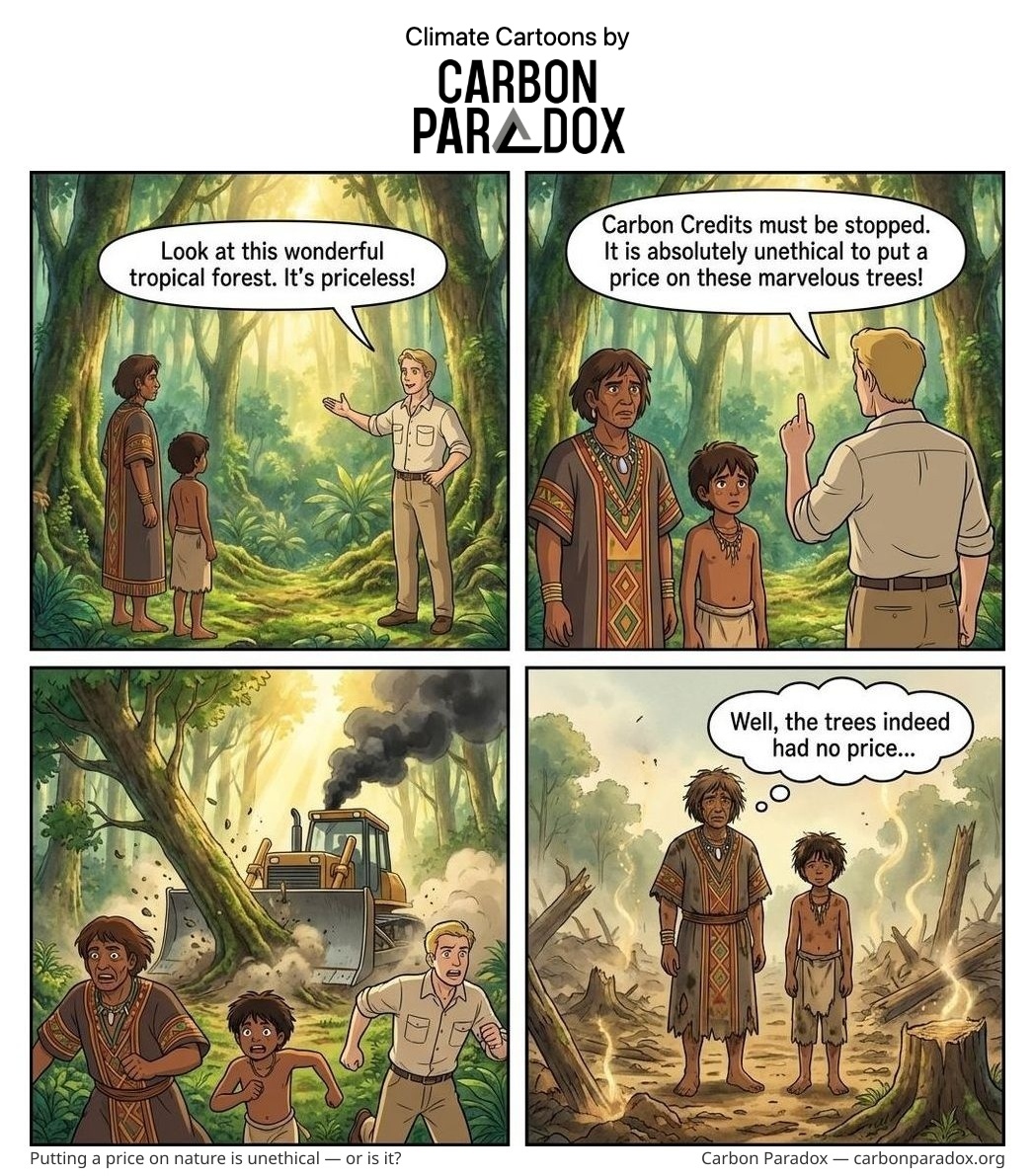
A Pricing Nature
Putting a price on nature is unethical — or is it?
-
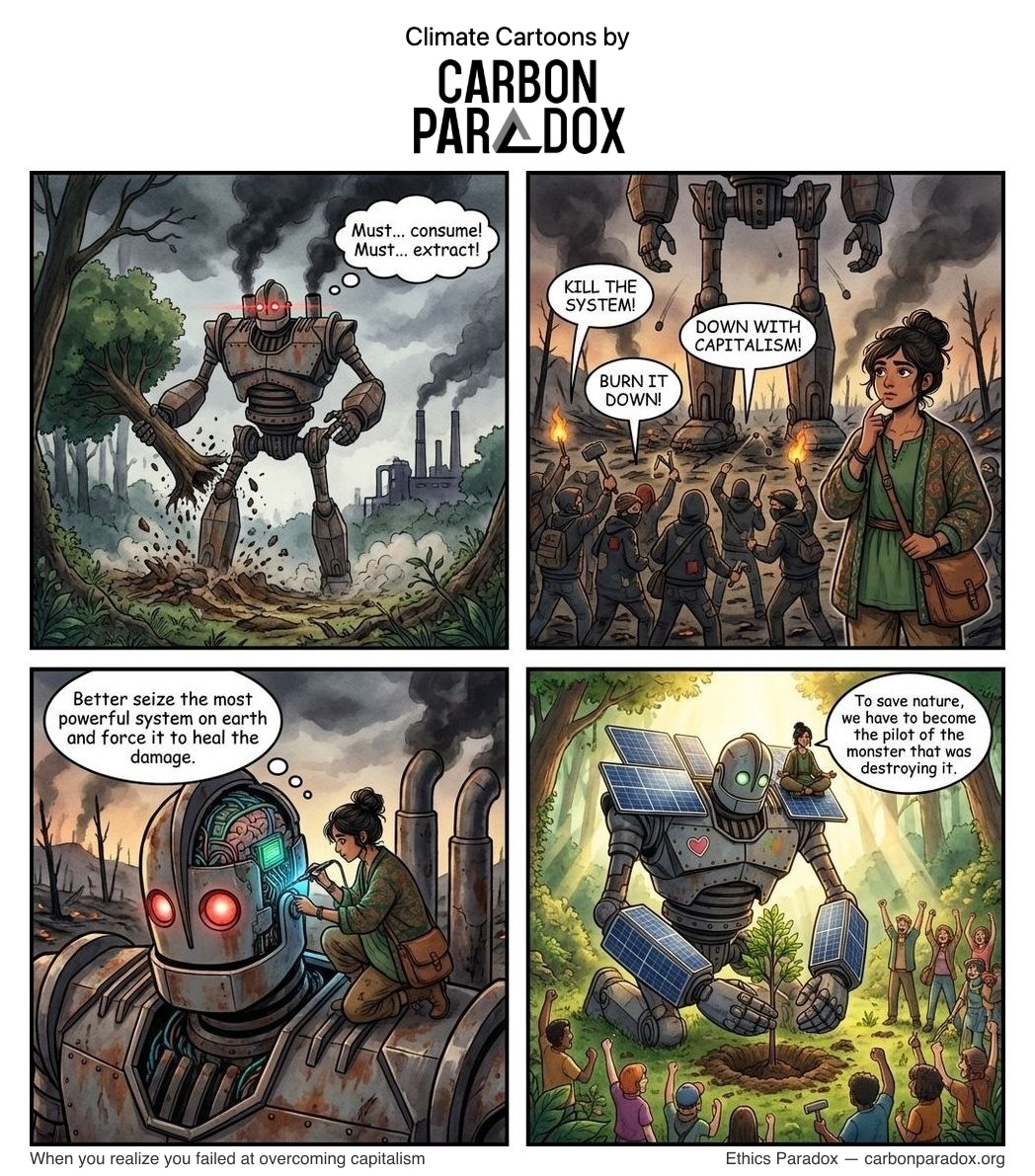
B Capitalism
When you realize you failed at overcoming capitalism
-
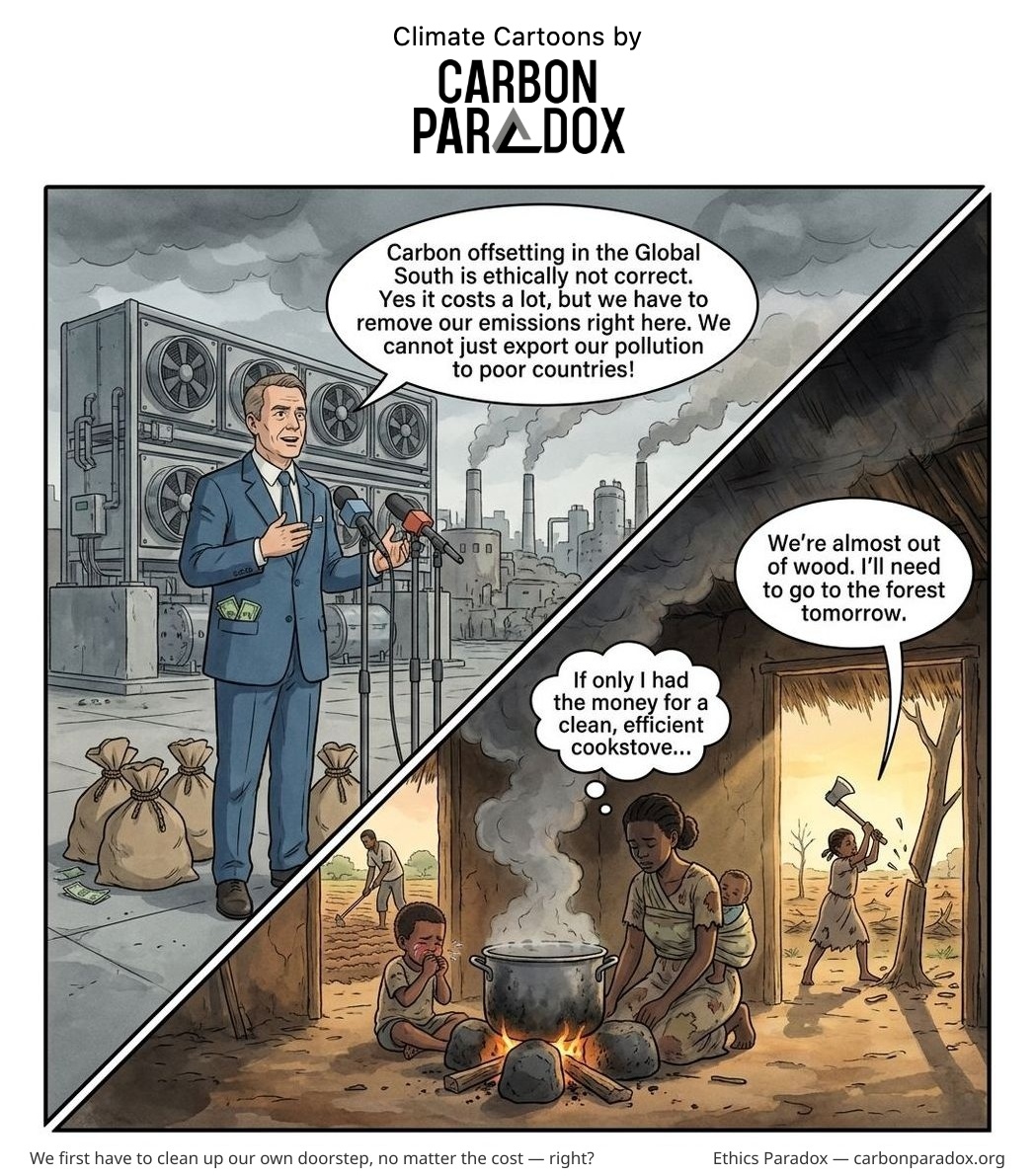
C Domestic vs. Abroad
We have to clean up our own doorstep, no matter the cost
This paradox touches on ethics. Is it morally right to put a price on nature? Is it ethically correct to use capitalism, which caused much of the climate crisis, to solve it? And here’s another: is it ethical to develop carbon projects in poorer countries when wealthier nations caused most of the damage?
We degrade nature because we value dead wood more than living forests. Carbon credits are one way of correcting that by recognising the value of nature’s ecosystem services. But can money-driven solutions truly respect the intrinsic value of ecosystems and communities?
At first glance, it appears immoral – but paradoxically, you can argue the exact opposite, too: Is it moral NOT to use every tool at our disposal to fight climate change, particularly a powerful tool like capitalism? Is it moral NOT to prioritise projects in those countries that are most affected by climate change?
It’s a delicate balance–a tightrope walk between virtue and pragmatism, deep ecology and environmental finance. Yet, finding that balance might be our best shot at tackling the climate crisis.
Let’s discuss it! Should the Global North fund projects in the Global South? Can capitalism and morality coexist in climate action? Or do you think the opposite is true? 💬👇
Three flavours of the Ethics Paradox
How to solve this paradox?
Comments (8)
Marina Herias-Saenz
Whether moral or not, it is the realistic approach to accept we live in a capitalist world and exactly the way to improve it and regenerate it can be giving value to nature capital, transforming nature into a valuable asset class, so to speak. Climate action in this way can transform our current economic systems into more regenerative ones, arguably thus more ethical ones. Additionally, carbon projects when effectively and equitably implemented yield substantial benefits for local communities and economies. What is more, as far as nature-based carbon projects are concerned, the environmental and social impact per hectare is substantially higher in the Global South. And, yes, it is a way of giving back and recirculating value to the most precious places in our planet, where capitalism took most of it from.
Ramazan Aslan
I think there is no paradox here: developed countries need to pay to global south for their historic and ongoing emissions. Meantime they need to speed up decarbonization actions without any delay.
Carbon credits indeed is one of the most effective way to support and/or compensate most vulnerable countries by the develop countries. Classic financial system, mostly governed by banks, does not work effectively and cannot support the most in needs, due to their stringent warranties requirements.
Offsetting should be regarded as temporary instrument to tackle with climate crisis which needs all tools to be deployed urgently to solve the problem. In order to be effective capitalism shall divert from carbon dense methods, so whilst the new carbon emitting investment tacking places, we cannot claim and effective offset market. Therefore, in the first place we need to discuss the reliance of current capitalist system on carbon and try to decarbonize the whole system, while making it more democratic and inclusive.
Aaron Marr Page
An important debate, yes with some paradoxical dimensions. I think it can be usefully broken in two: the foundational question (markets inherently bad or inappropriate), the applied question (historical legacy/justice, markets structured to serve current interests and disadvantage others and no real indicator that market makers are willing to make fundamental change). This allows us to move past the folks in the first camp, but leaves us more clearly face-to-face with the serious objections of the second camp. There are definitely examples of marginalized groups using markets to build power, but they are faaar outweighed by examples of markets continuing marginalization. Until we change that ratio, will any analytical arguments be convincing? Should they be?
James Macgregor
Yes, agree with your counter-points – it is not moral that we have not previously placed any value in nature (and natural capital for that matter), so some value is better than nothing.
Carbon credits are a great way to quickly distribute money and investment to the global south.
The real challenge paradox here is the financing of the carbon projects. Project verification and registration is expensive and the financing has to be obtained somehow.
This is where the opportunity lies for financiers of projects to be greedy. It is imperative to support project development with access to cheap capital.
Anna Gatti
I reccommend a great read on this: What Money Can’t Buy: The Moral Limits of Markets by Michael J. Sandel.
CHEN, Haolin
I think there is no paradox here. Capital is only a tool, even we used it to create natural problems, we can also use it to solve the problems.
The question we are facing is that the distrbution of capital is inbalance, for example, climate pollution is a global things, but the most sever areas have way less capital than those developed areas to slove the problem. Neither can capital freely flow to solve them, since the capital market’s regulation in different area is different.
In today’s anti globalization era, how to break down barriers that hinder capital flow may be the first huge question we need to solve
ZHU CHENYI
Capitalism can be a constrained tool for climate action if guided by ethics: Regulate markets to prioritize real emissions cuts and fund high-quality carbon removal (not offsets-as-excuses). Price nature to protect it, but center Indigenous rights and ecosystems’ intrinsic value—don’t reduce forests to tradable commodities. Global North must pay (as reparations, not offsets) for projects in the Global South, but communities lead—no green colonialism. Moral urgency demands action: Use markets pragmatically alongside degrowth, renewables, and justice.
ZHUCHENYI
Capitalism can be a constrained tool for climate action if guided by ethics: Regulate markets to prioritize real emissions cuts and fund high-quality carbon removal (not offsets-as-excuses). Price nature to protect it, but center Indigenous rights and ecosystems’ intrinsic value—don’t reduce forests to tradable commodities. Global North must pay (as reparations, not offsets) for projects in the Global South, but communities lead—no green colonialism. Moral urgency demands action: Use markets pragmatically alongside degrowth, renewables, and justice.