ParadoxeParadox 1
Das Ethik-Paradox
Dieses Paradox berührt ethische Fragen. Ist es moralisch vertretbar, der Natur einen Preis zuzuweisen? Ist es ethisch korrekt, den Kapitalismus, der einen Großteil der Klimakrise verursacht hat, zu ihrer Lösung einzusetzen? Und noch eine Frage: Ist es ethisch vertretbar, CO₂-Projekte in ärmeren Ländern zu entwickeln, wenn die reicheren Nationen den größten Teil des Schadens verursacht […]
Drei Spielarten
Ein Paradox, drei Comics: drei Wege in dieselbe Falle.
-
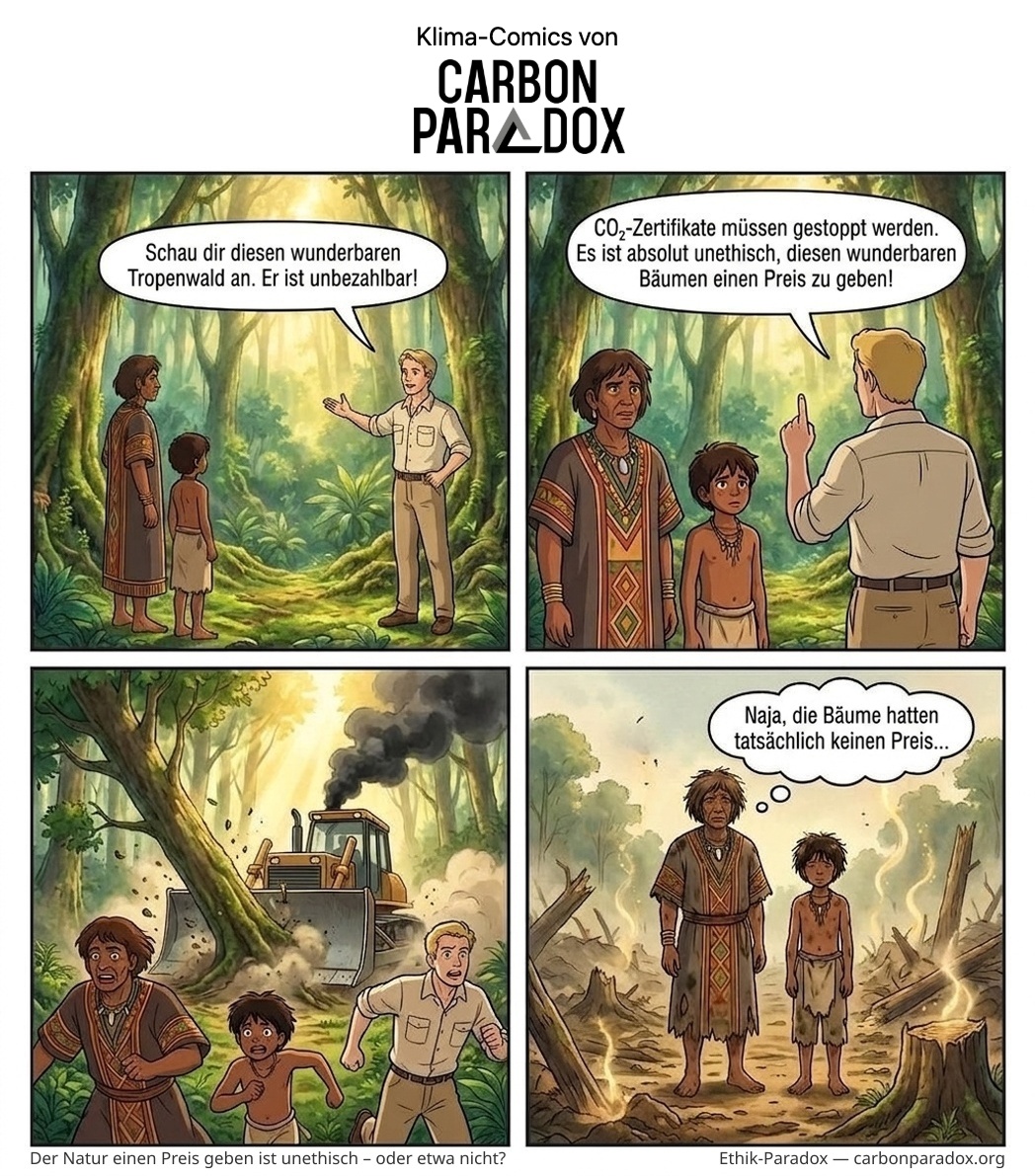
A Ein Preis für die Natur
Der Natur einen Preis geben ist unethisch – oder etwa nicht?
-
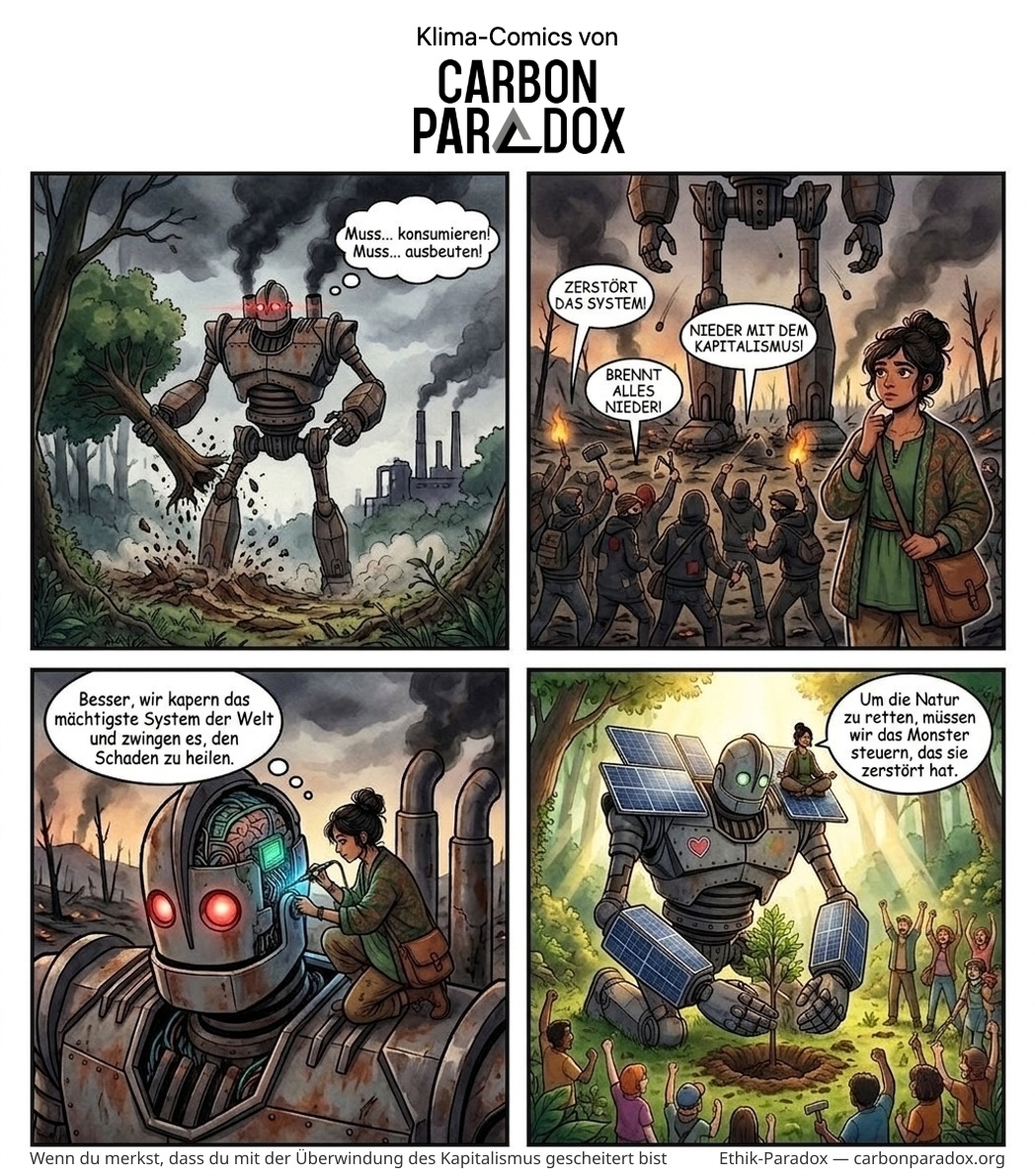
B Kapitalismus
Wenn du merkst, dass du mit der Überwindung des Kapitalismus gescheitert bist
-
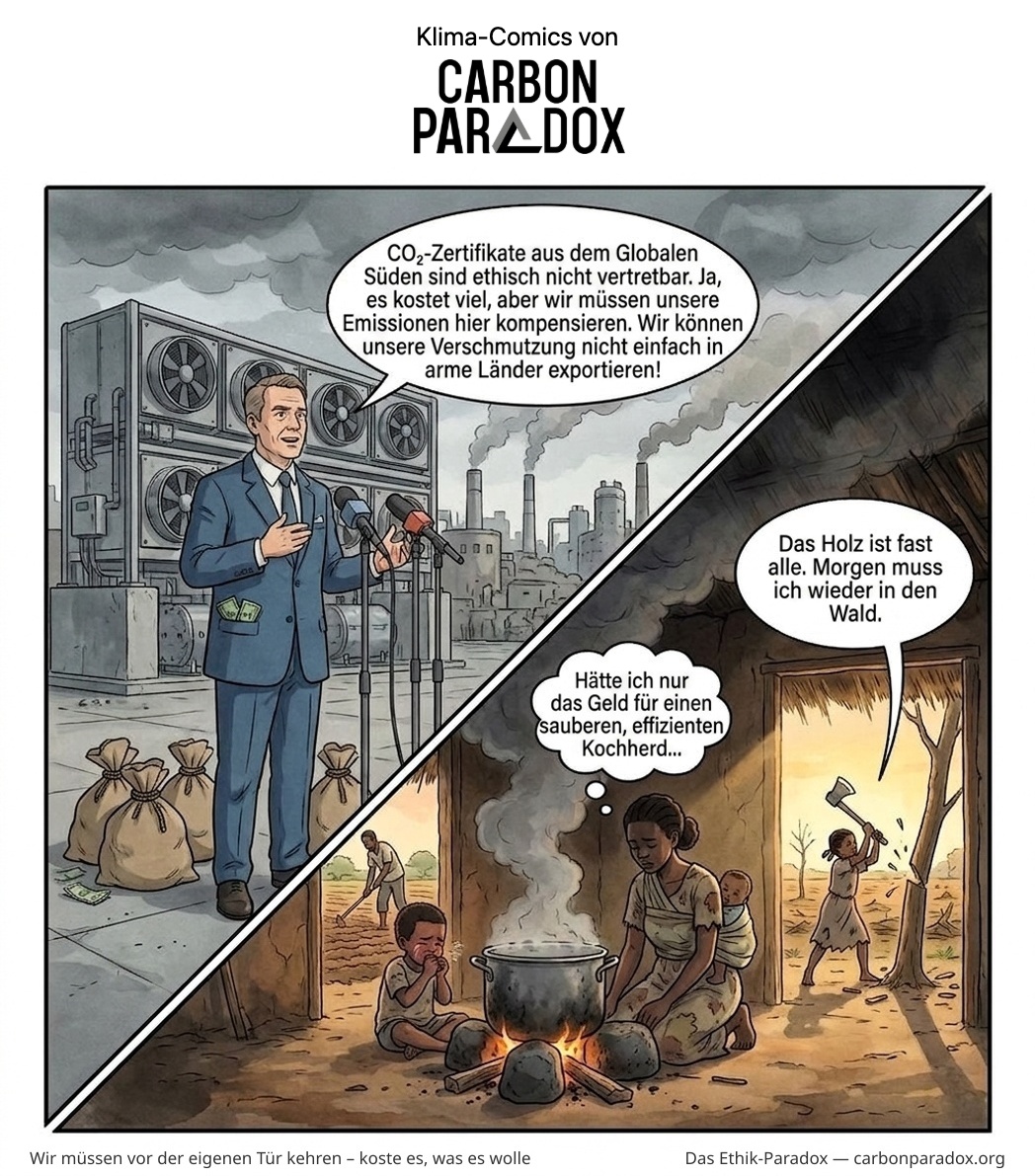
C Inland vs. Ausland
Wir müssen vor der eigenen Tür kehren – koste es, was es wolle
Dieses Paradox berührt ethische Fragen. Ist es moralisch vertretbar, der Natur einen Preis zuzuweisen? Ist es ethisch korrekt, den Kapitalismus, der einen Großteil der Klimakrise verursacht hat, zu ihrer Lösung einzusetzen? Und noch eine Frage: Ist es ethisch vertretbar, CO₂-Projekte in ärmeren Ländern zu entwickeln, wenn die reicheren Nationen den größten Teil des Schadens verursacht haben?
Wir schaden der Natur, weil wir totes Holz höher schätzen als lebendige Wälder. Emissionszertifikate sind eine Möglichkeit, dies zu korrigieren, indem sie den Wert der Ökosystemleistungen der Natur anerkennen. Aber können geldorientierte Lösungen den inneren Wert von Ökosystemen und Gemeinschaften wirklich würdigen?
Auf den ersten Blick erscheint es unmoralisch – doch paradoxerweise lässt sich auch genau das Gegenteil argumentieren: Ist es moralisch vertretbar, NICHT jedes uns zur Verfügung stehende Mittel zur Bekämpfung des Klimawandels einzusetzen, insbesondere ein so wirkungsvolles Instrument wie den Kapitalismus? Ist es moralisch vertretbar, Projekten in den Ländern, die am stärksten vom Klimawandel betroffen sind, KEINE Priorität einzuräumen?
Es ist ein empfindliches Gleichgewicht – ein Drahtseilakt zwischen Tugendhaftigkeit und Pragmatismus, Tiefenökologie und Umweltfinanzierung. Doch dieses Gleichgewicht zu finden, könnte unsere beste Chance sein, die Klimakrise zu bewältigen.
Lasst uns darüber diskutieren! Sollte der Globale Norden Projekte im Globalen Süden finanzieren? Können Kapitalismus und Moral im Klimaschutz nebeneinander bestehen? Oder glaubst du, dass das Gegenteil der Fall ist? 💬👇
Drei Facetten des Ethik-Paradoxes
Wie lässt sich dieses Paradox lösen?
Kommentare (8)
Marina Herias-Saenz
Whether moral or not, it is the realistic approach to accept we live in a capitalist world and exactly the way to improve it and regenerate it can be giving value to nature capital, transforming nature into a valuable asset class, so to speak. Climate action in this way can transform our current economic systems into more regenerative ones, arguably thus more ethical ones. Additionally, carbon projects when effectively and equitably implemented yield substantial benefits for local communities and economies. What is more, as far as nature-based carbon projects are concerned, the environmental and social impact per hectare is substantially higher in the Global South. And, yes, it is a way of giving back and recirculating value to the most precious places in our planet, where capitalism took most of it from.
Ramazan Aslan
I think there is no paradox here: developed countries need to pay to global south for their historic and ongoing emissions. Meantime they need to speed up decarbonization actions without any delay.
Carbon credits indeed is one of the most effective way to support and/or compensate most vulnerable countries by the develop countries. Classic financial system, mostly governed by banks, does not work effectively and cannot support the most in needs, due to their stringent warranties requirements.
Offsetting should be regarded as temporary instrument to tackle with climate crisis which needs all tools to be deployed urgently to solve the problem. In order to be effective capitalism shall divert from carbon dense methods, so whilst the new carbon emitting investment tacking places, we cannot claim and effective offset market. Therefore, in the first place we need to discuss the reliance of current capitalist system on carbon and try to decarbonize the whole system, while making it more democratic and inclusive.
Aaron Marr Page
An important debate, yes with some paradoxical dimensions. I think it can be usefully broken in two: the foundational question (markets inherently bad or inappropriate), the applied question (historical legacy/justice, markets structured to serve current interests and disadvantage others and no real indicator that market makers are willing to make fundamental change). This allows us to move past the folks in the first camp, but leaves us more clearly face-to-face with the serious objections of the second camp. There are definitely examples of marginalized groups using markets to build power, but they are faaar outweighed by examples of markets continuing marginalization. Until we change that ratio, will any analytical arguments be convincing? Should they be?
James Macgregor
Yes, agree with your counter-points – it is not moral that we have not previously placed any value in nature (and natural capital for that matter), so some value is better than nothing.
Carbon credits are a great way to quickly distribute money and investment to the global south.
The real challenge paradox here is the financing of the carbon projects. Project verification and registration is expensive and the financing has to be obtained somehow.
This is where the opportunity lies for financiers of projects to be greedy. It is imperative to support project development with access to cheap capital.
Anna Gatti
I reccommend a great read on this: What Money Can’t Buy: The Moral Limits of Markets by Michael J. Sandel.
CHEN, Haolin
I think there is no paradox here. Capital is only a tool, even we used it to create natural problems, we can also use it to solve the problems.
The question we are facing is that the distrbution of capital is inbalance, for example, climate pollution is a global things, but the most sever areas have way less capital than those developed areas to slove the problem. Neither can capital freely flow to solve them, since the capital market’s regulation in different area is different.
In today’s anti globalization era, how to break down barriers that hinder capital flow may be the first huge question we need to solve
ZHU CHENYI
Capitalism can be a constrained tool for climate action if guided by ethics: Regulate markets to prioritize real emissions cuts and fund high-quality carbon removal (not offsets-as-excuses). Price nature to protect it, but center Indigenous rights and ecosystems’ intrinsic value—don’t reduce forests to tradable commodities. Global North must pay (as reparations, not offsets) for projects in the Global South, but communities lead—no green colonialism. Moral urgency demands action: Use markets pragmatically alongside degrowth, renewables, and justice.
ZHUCHENYI
Capitalism can be a constrained tool for climate action if guided by ethics: Regulate markets to prioritize real emissions cuts and fund high-quality carbon removal (not offsets-as-excuses). Price nature to protect it, but center Indigenous rights and ecosystems’ intrinsic value—don’t reduce forests to tradable commodities. Global North must pay (as reparations, not offsets) for projects in the Global South, but communities lead—no green colonialism. Moral urgency demands action: Use markets pragmatically alongside degrowth, renewables, and justice.